
Business awards can be easy to dismiss as vanity metrics. In practice, the right recognition can do much more: validate a company’s credibility, strengthen trust with clients and partners, support employer brand, and give internal teams proof that their work stands out beyond their own market. That is especially true when the judging process is structured and based on expert review.
In this article, I will share practical steps that can help businesses pursue credible international awards more strategically and effectively. It will be especially useful for PR managers, marketing leaders, founders, and business owners who want to turn real achievements into recognition that strengthens reputation, trust, and market positioning.
Awards: Vanity metrics or business impact?
Choosing the right awards program is just as important as preparing the entry itself. For business owners and PR managers, a good starting point is to look at credibility, relevance, and long-term value. Ask simple questions:
- Is the award recognized in your industry or region?
- Is the organizer a credible source?
- Is the judging process transparent?
- Are judges independent and experienced?
- Does the program attract strong companies and meaningful competition?
It is also worth considering what happens after the announcement, including:
- Feedback from the judges
- Media coverage and visibility
- Networking opportunities.
The best awards are those that align with your business goals, reflect real achievement, and earn recognition respected by clients, partners, and future talent.
This is one of the reasons Stevie® Awards programs are widely respected in the business world. Founded in 2002, the Stevie® Awards now run multiple international competitions, receive thousands of nominations from more than 70 nations, and use judging panels made up of more than 1,000 professionals worldwide each year. Each entry is reviewed and rated by at least five judges, and entrants receive judges’ comments after results are announced.
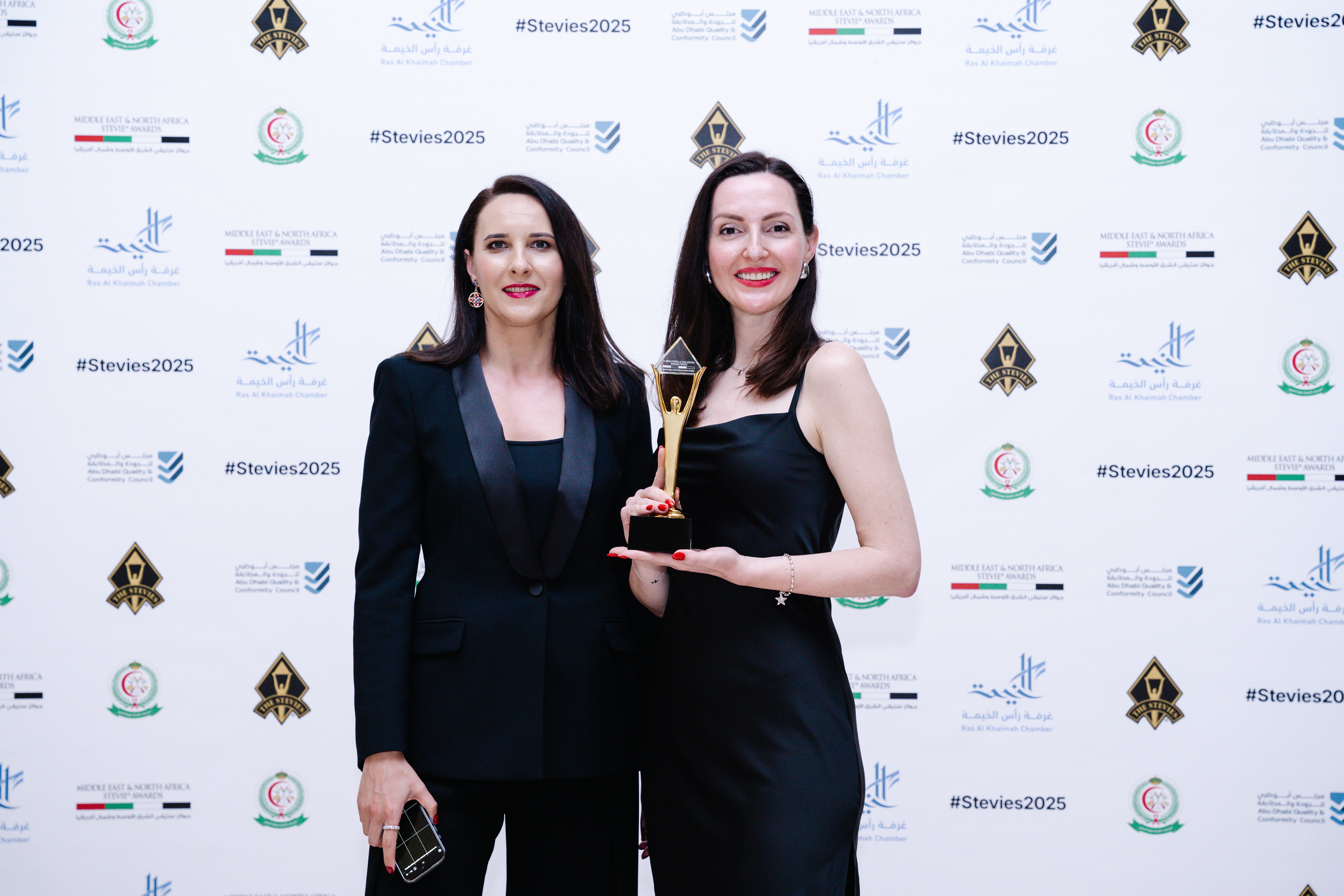
At ZONE3000, we have experienced that firsthand. Our company received a Gold Stevie® Award in the 2025 Middle East & North Africa Stevie® Awards for Innovative Achievement in Organization Recovery. We also received a Bronze Stevie® Award in the 2026 Stevie® Awards for Sales & Customer Service in Achievement in AI-Driven Sales Automation.
How to prepare an entry that deserves to win
From my perspective as a PR & Communications manager, a strong award is not only a logo for a website footer. It is a framework that helps you package achievements clearly, test whether your story is convincing to outside experts, and turn business results into a credible market narrative. A very important thing to remember is understanding how to prepare an entry that deserves to win. Below, I share tips based on my own experience that helped my company win credible business awards.
1. Start with business significance, not with self-praise
One of the most common mistakes in award submissions is trying to sound impressive instead of being specific. Judges do not need adjectives. They need evidence, context, and outcomes.
When we prepared ZONE3000’s organization recovery case, the story was not “we are resilient.” The real story was much more concrete. The majority of our team was based in Ukraine when the full-scale Russian invasion began. The challenge was to evacuate people, secure infrastructure, protect continuity, and keep client delivery stable under extraordinary pressure. The case became strong because it showed actions and results: safe workplaces, evacuation support, remote work readiness, cybersecurity enhancements, backup planning, stronger internal communications, and continuity of service.
The same principle worked in our AI-driven sales automation case. Instead of presenting AI as a trend, the entry focused on a real business problem: fragmented sales data, manual qualification, and limited visibility into opportunity readiness. The story became compelling when connected to the solution, technologies used, and business outcomes such as faster sales cycles, stronger forecasting, and better use of sales resources.
My first recommendation is simple: do not think like, “How do we make this sound award-worthy?” Emphasize, “What changed in the business, why did it matter, and what can we prove?”
2. Choose the category as carefully as you write the entry
A great story placed in the wrong category can easily become an average entry.
This is where many PR teams lose points. The temptation is to choose the broadest or most prestigious-sounding category. In reality, awards are won by relevance. The closer the fit between your case and the category criteria, the easier it is for judges to understand why the nomination belongs there.
In my experience, category selection is a strategic step. You need to study the category, compare it to your actual achievement, and decide on the strongest angle. Is your case about innovation, leadership, customer impact, technology implementation, team performance, or market growth?
If you are not fully sure which category fits best for your story, it is absolutely fine to contact the organizers and ask for guidance. A short clarification can help you avoid a mismatch and significantly improve the chances of placing your case in the category where it has the strongest potential.
3. Treat communication with organizers as part of the process
One thing I value in awards programs is the quality of communication with organizers. Good organizational communication reduces uncertainty and helps applicants navigate categories, deadlines, and practical requirements with more confidence.
With Stevie® Awards, the process is structured and transparent, supported by entry kits, category descriptions, FAQs, and competition-specific materials. They also regularly run free live webinars for entrants on topics such as choosing categories, understanding the judging process, and crafting stronger nominations. In my own experience, attending these webinars was genuinely helpful: they made it easier to see that we already had strong stories worth submitting and helped me understand how to shape them into award-ready entries.
My advice is to approach organizers’ materials the same way you would approach a media brief: read carefully, use the available resources, and take advantage of webinars and Q&A opportunities to strengthen your submission before you enter.
4. Write for judges, not for your website
Award entries are not marketing brochures. They are evidence-based narratives. A strong submission usually has three qualities.
- It gives enough context for an outside reviewer to understand the scale of the challenge.
- It explains the solution in plain business language, not only internal terminology.
- It proves outcomes with facts, metrics, or credible indicators.
- It includes strong supporting materials that back up the claims made in the nomination, through links, visuals, case examples, testimonials, or other relevant evidence.
This is also where PR expertise becomes especially valuable. A communications professional knows how to structure a story so that technical, operational, and business details become readable without losing precision. In many companies, the achievement already exists, but the narrative does not. Building that narrative is the real work.
5. Respect the judging process and use the feedback
What makes awards especially useful is that the process does not end when results are announced. In the Stevie® Awards, entrants receive judges’ anonymous comments, which also function as a valuable external review mechanism. Based on my experience with other awards programs, receiving judges’ comments is not always typical, which makes this a real advantage of the Stevie® Awards process.
That is valuable for two reasons. First, feedback helps you understand how your story was perceived by external reviewers. Second, it can make future submissions stronger. Sometimes, comments show that the case itself was strong but presented too broadly. In other cases, they highlight that the business impact was compelling, but the evidence was not supported clearly enough, for example, through stronger supporting materials, external links, or proof points.
The smartest way to approach awards is not to submit once and simply hope for the best. It is to learn from the process, refine your approach, and build a stronger recognition strategy over time.
6. Do not underestimate the ceremony and networking value
Awards ceremonies are often viewed as symbolic, but they can also be highly practical. Stevie® Awards ceremonies bring together winners, judges, executives, and guests from multiple industries, and official ceremony information highlights networking, on-stage recognition, photography, and interviews as part of the experience.
For communications teams, this creates additional value around the award itself. The ceremony can become an opportunity for content, establishing relationships, and visibility.

7. Plan your post-award communication before the result arrives
Winning is not the end of the story. It is the start of a communications cycle. If you wait until the award is announced to decide what to do with it, you lose momentum.
Prepare a post-award plan in advance:
- internal communications
- LinkedIn content
- media outreach
- leadership commentary
- website updates
- case-study repackaging
- award page integration
- partner-facing materials.
The goal is not to overpromote. The goal is to translate recognition into trust.
Final thoughts: Turn recognition into business assets
If I had to sum it up in one principle, it would be this: business awards are won through strong achievements, clear storytelling, solid evidence, and professional communication.
At ZONE3000, our strongest award results have come not only from the recognition itself, but also from how we turned that recognition into a credible business narrative. Our awards and recognitions also support marketing and sales efforts by helping demonstrate trust, credibility, and proven expertise when approaching new leads. Referring to winning cases allows us to show the business community tangible results, strengthen our market positioning, and attract new partners and clients.
My advice: Identify what is truly meaningful inside the business, shape it into a credible narrative, and present it in a way the market can trust. That is how awards become more than recognition. They become business assets
.png)