When Natasha Bansgopaul helped establish a financial technology firm focused on alternative investments, she knew getting clients to ditch their existing methods of evaluating funds and raising capital wasn’t going to be easy. The bigger challenge: acting as a minority change agent who also happens to be female.
“People tend to underestimate you. This is especially true in financial services and technology industries, which are trying to rally to incorporate more women leaders throughout,” says Bansgopaul. “The advantage is that I’m always able to over-deliver and to lead my team accordingly. You can perform well beyond expectations when you’re underestimated.
“The disadvantage, though, is that you always feel the need to prove yourself and to deem yourself ‘valued’ or ‘worth it’ in order to combat the perception,” the entrepreneur says. “I focus on debunking the myths and letting our deliverables speak for themselves.”
Transforming the Industry
More than four years into DarcMatter, her venture that’s based in New York, New York, United States, the cofounder and COO has proven more than a few people wrong. The firm has become a key researching and networking platform for investors and fund managers involved in alternative investments—a category that includes hedge funds, venture capital funds, and financial derivatives.
Qualified investors (typically financial advisers), institutions, and high-net-worth individuals can use DarcMatter to explore pre-vetted funds, to perform due diligence, and to purchase shares online. It’s quite a change for industry insiders who, believe it or not, still frequently use more traditional channels to share information, including fax machines and “snail mail.”
“Our mission is to enhance capital flow, transparency, and efficiency for clients by providing direct and comprehensive access to funds in the asset management industry,” says Bansgopaul, who started the business with college friend Sang Lee in 2014.
One of her main responsibilities these days is broadening the brand awareness of DarcMatter via speaking invitations in the United States and abroad in South Korea, as well as spearheading the company’s product development and blockchain integration initiatives. Recently, the team announced the launch of “Konstellation,” the blockchain development and consulting division of DarcMatter, geared towards financial institutions with dedicated internal blockchain development teams.
Since July 2017, she’s helped grow the company’s user base by over 60 percent. Today, DarcMatter hosts information on more than 150 live fund products and has upwards of 2,900 registered investors using the platform around the globe.
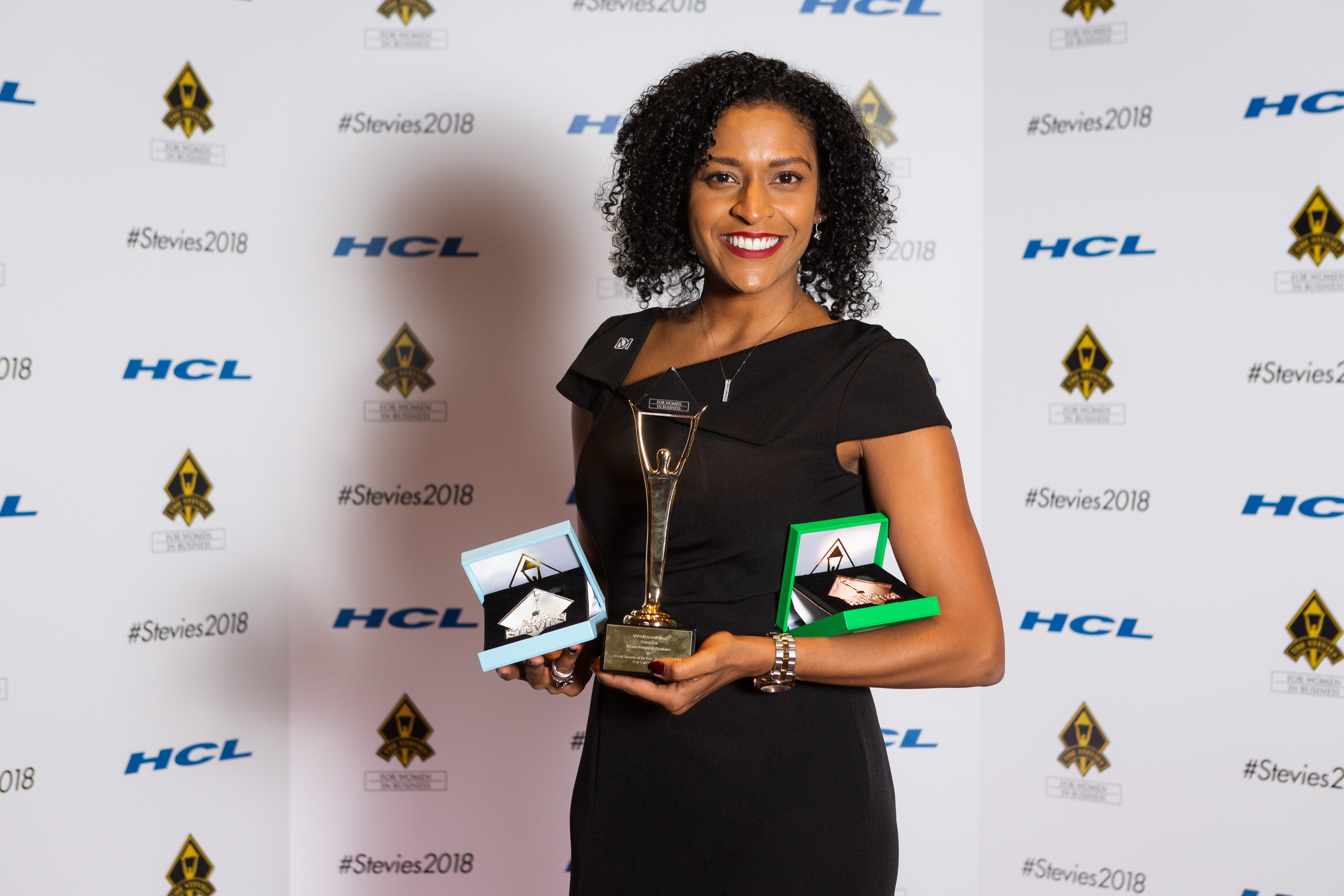
Bansgopaul was honored for those accomplishments last November with a Gold StevieⓇ Award for Female Executive of the Year and a Silver for Female Entrepreneur of the Year in the Stevie Awards for Women in Business. DarcMatter also received a Bronze in the Company of the Year category.
“It was an amazing honor to be selected amid stiff competition from over 1,500 finalists from more than 30 countries,” she says. “I’m truly proud to represent the DarcMatter team.”
Interested in entering the Stevie Awards for Women in Business this year?

Paying It Forward
DarcMatter, which has offices in South Korea, China, and Ukraine, boasts a particularly diverse management team for the financial technology (fintech) industry, which is something Bansgopaul definitely takes pride in.
“As a company with a black female founder with an MBA, a Korean-American cofounder, and a Ukrainian chief technology officer, our management team comes from culturally diverse upbringings,” she says. “We tout a wealth of diverse experience from various sectors, including traditional financial services, CPG, and corporate strategy, as well as product and SAAS technology development.”
The executive is aware, however, that there’s a long way to go before women attain equal footing in her industry. According to a gender diversity report published by Mercer, women comprise 46 percent of all employees in the financial services sector but only 15 percent of leadership positions. Currently, DarcMatter has seven female employees, representing 35 percent of its total employee count. Bansgopaul hopes that number will continue to grow.
“As a female in a position of power, I am laser focused on hiring qualified female candidates. I hope to assist in their growth and development within financial technology firms, which should, in turn, help to build a new class of diverse female talent. Moving forward, they can then recruit candidates like themselves, and this positive cycle will continue,” says Bansgopaul.




 One particular victim moved Allert so deeply that, in 2007, Allert decided to launch the
  Like any industry, the bottom line drives fashion-related businesses, and technological advances are constantly challenging that bottom line. However, the data points collected from searches and purchases are narrowing the gap between product supply and demand, meaning product numbers are more accurate, and fewer materials are wasted. Data are also helping companies predict trends and provide products their customers actually like and want.
  At the time, the company marketed a wide range of products, from home goods to natural food products. The latter gave Ponan hope. After all, she knew firsthand the importance of a carefully selected diet. The entrepreneur suffers from multiple food allergies to this day and survived two acute cases of pancreatitis as a young girl.
  The presentations were